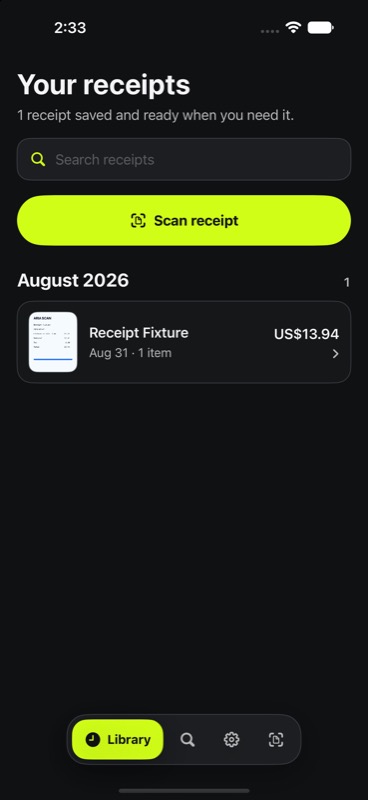
Capture should preserve proof. Purchase memory should preserve meaning: what was bought, when action is still possible, and where the original evidence lives.
Most receipt scanners stop at extraction. They photograph the paper, identify a merchant and total, and declare the job complete. That is useful for bookkeeping. It is not enough for the moment a person is standing at a service desk months later trying to prove what they bought.
The paper itself is a fragile source. The U.S. National Archives notes that thermal paper is still used for cash-register receipts and that some types can darken or fade until the information becomes illegible. A photograph preserves the visible evidence, but the future question usually needs more than an image.
Proof and memory are different jobs
Proof answers: Did this transaction happen? Purchase memory answers: What did I buy, can I still return it, is the warranty active, and where is the document that proves it? A useful system connects both jobs instead of treating the scan as the final product.
- The original receipt image, preserved without destructive edits.
- Merchant, date, total, currency, and individual items.
- A return deadline the user can verify and correct.
- Warranty duration and the product it belongs to.
- Notes, categories, and search terms that match how people remember purchases.
- A reminder early enough to allow action, not merely announce that a deadline passed.
Extraction should admit uncertainty
Receipts are hostile documents. They curl, tear, fade, use tiny type, mix discounts with item prices, and place several dates on the same strip of paper. Any scanner that silently converts uncertain text into certain records will eventually create a confident mistake.
A better capture flow waits until the receipt is readable, keeps manual capture available, and shows the extracted details for review. Suggested return or warranty dates should remain suggestions until a person can verify them. Explainability matters more than the appearance of perfect automation.
Search should follow human memory
People do not always remember that a replacement cable came from a particular merchant on a particular Tuesday. They may remember ‘USB-C,’ ‘office,’ ‘trip,’ or ‘the adapter I bought before the monitor arrived.’ Search works better when it can use merchant, item, category, note, date, total, and currency instead of forcing one filing system.
Receipts deserve privacy by default
A receipt library can reveal where a person shops, what they eat, which medicines or household goods they buy, how much they spend, and when they are away from home. That is not disposable metadata. It is a behavioural record.
ARIA Scan therefore keeps the purchase library on the device by default, does not require an ARIA account, and does not use receipt contents for advertising or third-party tracking. Optional iCloud sync is a user choice rather than a condition of using the product.
The useful moment happens later
The quality of a receipt app is not measured only at capture. It is measured weeks later, when a return window is closing; months later, when a device fails; or at tax time, when the original proof must be found quickly. The scan is merely the entrance. The product is the memory that remains usable afterward.