A useful daily system should not ask, “What is on every list?” It should help answer, “What genuinely needs me now, and what is safe to leave for later?”
A bill can be recorded correctly. A task can have the right due date. A calendar can contain every appointment. Yet the day can still feel impossible to read. The information is present, but the relationships between it are missing.
That separation creates a quiet tax. The brain has to remember that tomorrow’s appointment changes today’s available time, that Friday’s bill changes what is safe to spend, and that a task marked urgent may matter less than a commitment that is not making noise yet.
For people living with ADHD, this can collide with difficulties around attention, staying on task, and organization. The National Institute of Mental Health describes those as common features of ADHD, while also making clear that diagnosis and treatment belong with qualified professionals. Software is not treatment. It can, however, remove avoidable reconstruction work from an already busy day.
The problem is not another missing list
Most productivity software begins by separating life into clean categories. Money belongs in finance. Tasks belong in reminders. Time belongs in a calendar. That separation is useful for storage, but it is often the wrong shape for a decision.
A decision happens across categories. Can I buy this today? Only after upcoming bills and goals are visible. Should I start this task now? Only after the available time and competing commitments are visible. Is this reminder truly urgent? Only after its consequence is understood.
Information becomes useful when it arrives with enough context to change a decision.
Context changes priority
Priority is not a colour, a flag, or the order in which items were entered. It is a relationship between consequence, time, effort, money, and the person’s current capacity. A rigid list hides most of that. A useful daily view brings just enough of it back.
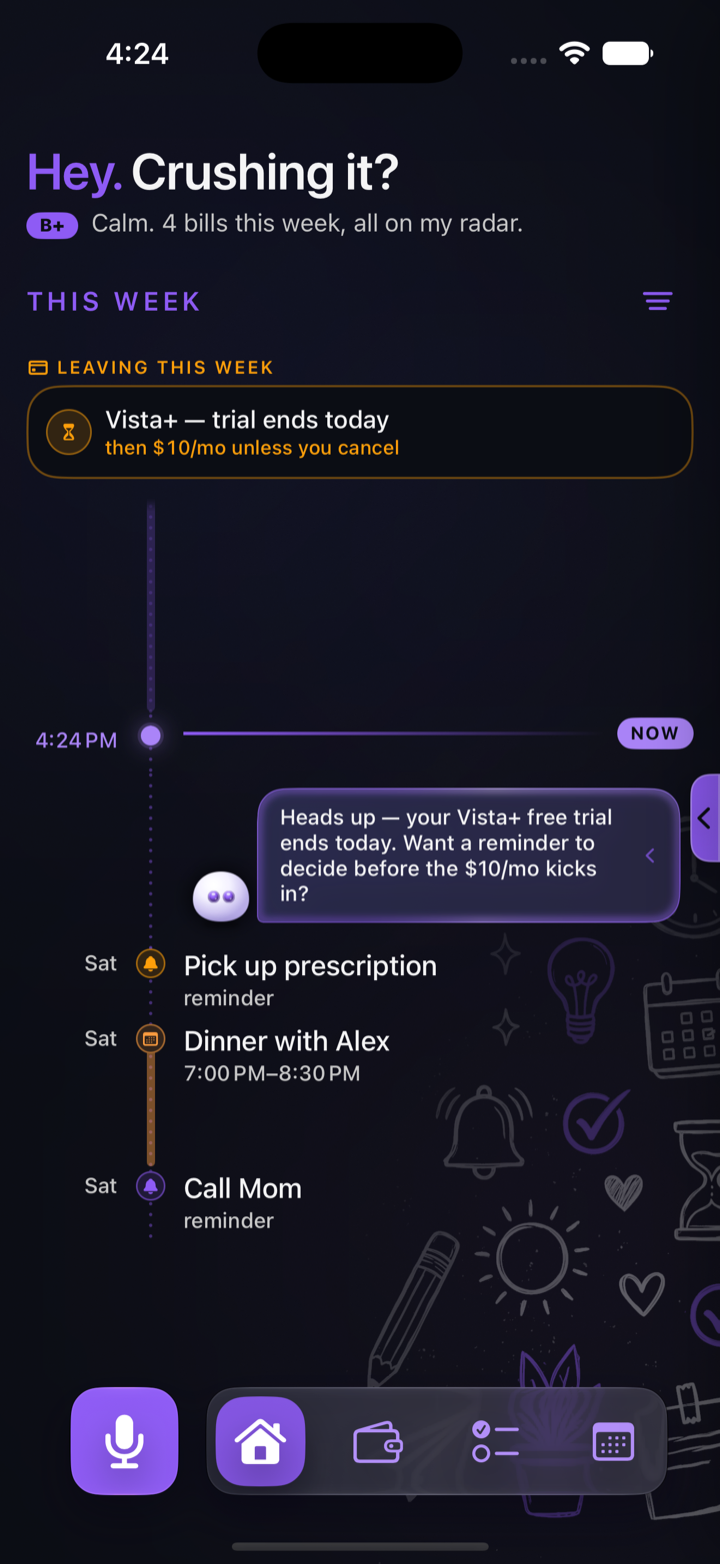
This is why ARIA’s home view does not attempt to reproduce every finance screen, every calendar view, and every task list. It surfaces a smaller shared picture: what needs attention, what is coming, and what remains safe after obligations are accounted for.
One daily surface, not one giant dashboard
Combining context can easily create a worse problem: a dashboard dense enough to become another source of avoidance. The answer is not to show everything at once. The answer is progressive disclosure—begin with the decision, then make the supporting detail available when it is needed.
- Start with today rather than the entire backlog.
- Separate what needs attention now from what can wait.
- Show the calculation behind a money number instead of presenting false certainty.
- Keep calendar load near tasks that require actual time.
- Let people correct, defer, or ignore a suggestion without punishment.
Calm is a product constraint
Calm software is not beige software with fewer buttons. It is software that earns interruptions, explains its conclusions, and stays quiet when it has nothing useful to add. That requires boundaries: read-only financial connections, reviewable suggestions, visible assumptions, and no artificial streak designed to make the app itself feel urgent.
The goal is not a perfectly optimized person. It is a day that can be understood without reopening four tools and rebuilding the situation from memory. When the system works, the next action feels smaller because the surrounding uncertainty has already been reduced.